
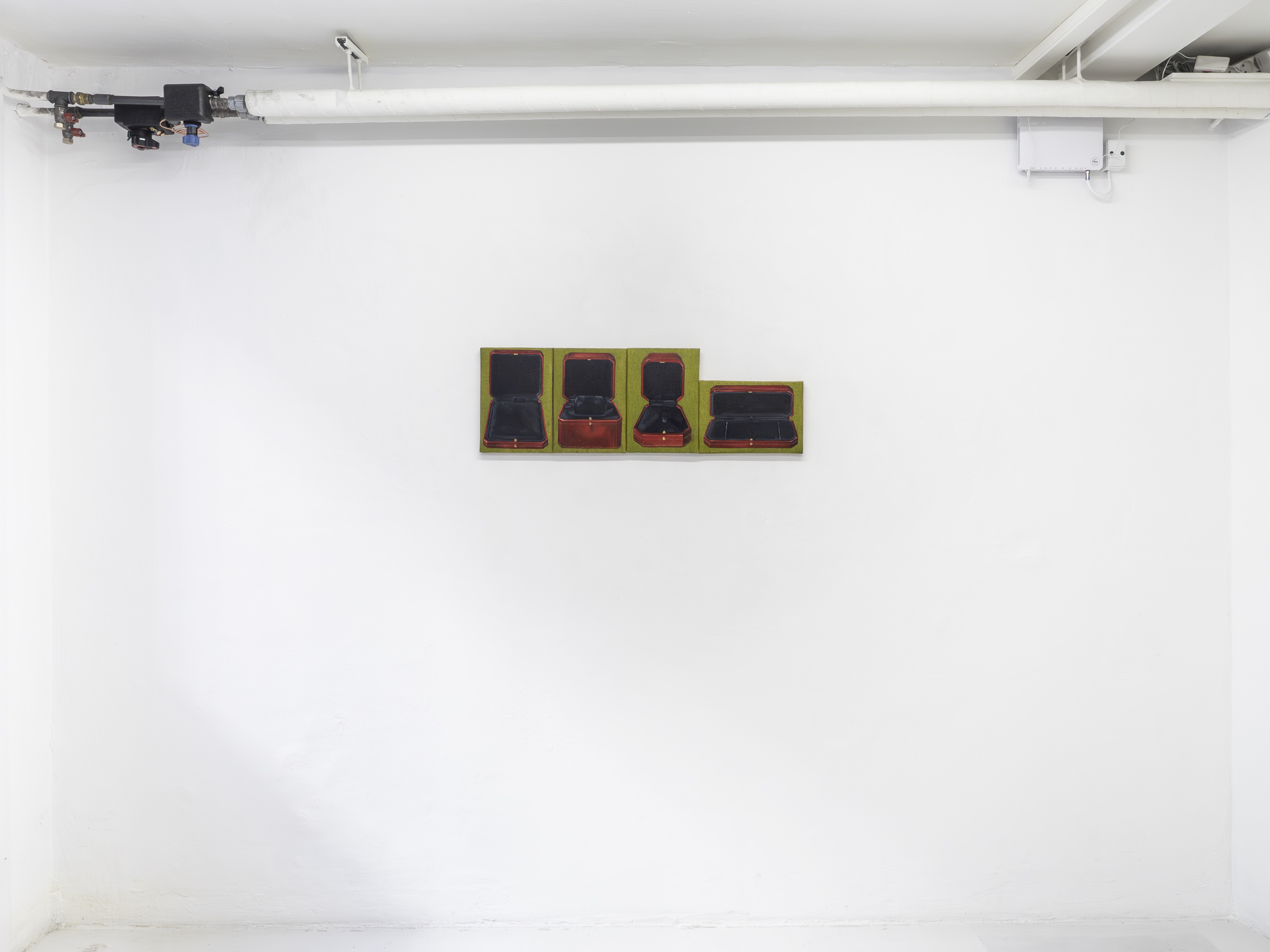

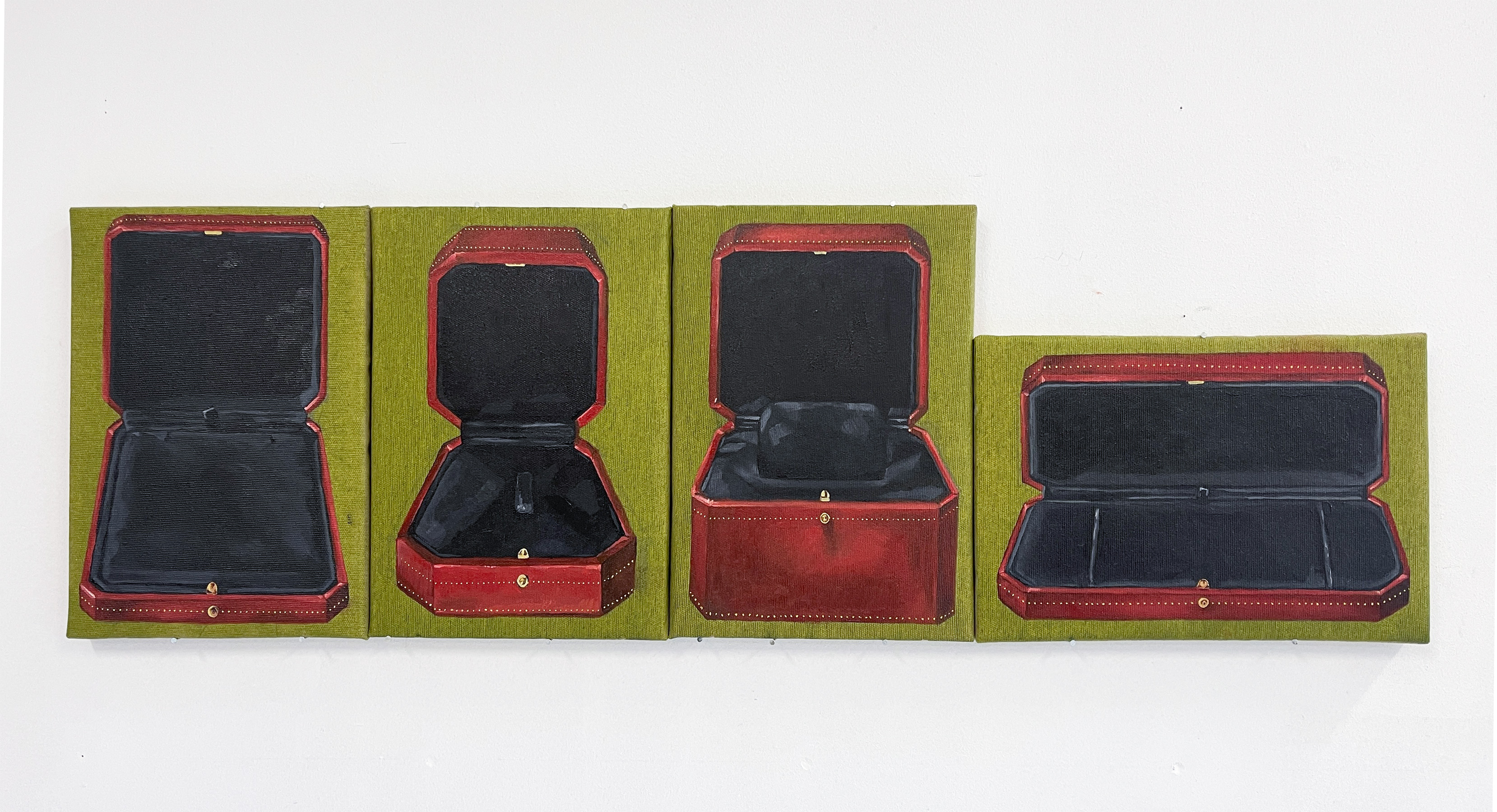


Alibi I-IV, 2025
Ming Yuan
21 x 29 x 2 cm each
Oil on cotton canvas
Öl auf Baumwolle
Alibi IX-XI, 2026
Ming Yuan
25x25x5 cm
Oil on cotton canvas
Öl auf Baumwolle
![]()
![]()
![]() Stirring Stills
Stirring Stills
21.2.25 - 29.3.25
Isaak Fangel, Copenhagen
A group exhibition featuring works by Christian John Munks, Giulio Noccesi,
Kristoffer Bech, Ming Yuan, Naja Zethner and Zuzanna Bartoszek
exhibition text by Helena Steffensen.
read more
![]()
![]()
'' In Between Transit ''
23.5-19.7.26
Kadel Willborn, Düsseldorf
Curated by Kim-Camille Kreuz
with Andria Dolidze, Amelie Karweick, Ming Yuan,
Moreno Schweikle, Paola Siri Renard, Ja Jess & Jessica
read more
![]()
![]()
![]()
![]()
![]()
Time is the Thing a Body Moves through
14.03 - 6.5.2026
Hua International, Berijing
Ming Yuan, and Chen Dandizi
exhibiton text by Lily-Rose Ricaud-Le Nagard
read more
![]()
![]()
![]()
Steinstraße Siebzehn
08.03-11.04.2026
JVDW, Düsseldorf
A group exhibition with works from Linus Berg, David Ostrowski,
David Schiesser, Hannah Sopie Dunkelberg, Ming Yuan,
Willi Beermann, and Mona Schulzek
read more
Ming Yuan
21 x 29 x 2 cm each
Oil on cotton canvas
Öl auf Baumwolle
Alibi IX-XI, 2026
Ming Yuan
25x25x5 cm
Oil on cotton canvas
Öl auf Baumwolle

21.2.25 - 29.3.25
Isaak Fangel, Copenhagen
A group exhibition featuring works by Christian John Munks, Giulio Noccesi,
Kristoffer Bech, Ming Yuan, Naja Zethner and Zuzanna Bartoszek
exhibition text by Helena Steffensen.
read more

'' In Between Transit ''
23.5-19.7.26
Kadel Willborn, Düsseldorf
Curated by Kim-Camille Kreuz
with Andria Dolidze, Amelie Karweick, Ming Yuan,
Moreno Schweikle, Paola Siri Renard, Ja Jess & Jessica
read more


Time is the Thing a Body Moves through
14.03 - 6.5.2026
Hua International, Berijing
Ming Yuan, and Chen Dandizi
exhibiton text by Lily-Rose Ricaud-Le Nagard
read more


Steinstraße Siebzehn
08.03-11.04.2026
JVDW, Düsseldorf
A group exhibition with works from Linus Berg, David Ostrowski,
David Schiesser, Hannah Sopie Dunkelberg, Ming Yuan,
Willi Beermann, and Mona Schulzek
read more
Some years ago, I was a punk.
Ming Yuan
Edited by Steven Zultanski
18.12.2024
Copenhagen
1
Some years ago, I was not a punk.
I was a middle class Taylor Swift fan.
The year of 1980 was the beginning of China’s one child policy and marked the turning point of the generational wealth leap. I was born a generation later: an only child, wrapped in Ralph Lauren skirts, polo shirts, and parental love. Tennis lessons and piano classes were non-negotiable. The whirlwind economy moved millions of people upward, involuntarily rapidly, and with that came questions of spiritual barrenness and disorientated taste.
Western media once represented promises of pleasure and freedom. All my cool friends had their own Apple Music playlist filled with foreign chart hits as a symbol of the long prosperous west, its freedom of choice and passion for high quality life. My user friendly rationales consist of consuming Taylor Swift love stories and Andy Warhol replicas on mugs. I searched for fun but only got delayed pop culture. Frustrated, I realised that the epicentre of fun and cultural discourse probably lay elsewhere. Somewhere else, anywhere else, people were smarter, economic systems fairer, social welfare better. Life was filled with more music and art.
So, I arrived in Germany in search of an epiphany.
2
I lived in Charlottenburg and attended business school in Mitte but longed to move to Friedrichshain, drawn to the glorious rough-and-tumble of east Berlin. I wanted to cosplay history and dive into the world of black-clad club-goers. The Ralph Lauren days were over. I couldn’t bear for my party friends to see me in preppy outfits, so I stuck to black.
A few friends ushered me into the fading local post-punk and noise scene. At a semi-concert, semi-DJ set, I found myself surrounded by middle-aged people in black suits, lipstick, and Mohawks. I felt like a tourist walking through Madame Tussaud’s wax museum. Minimalist punks as art pieces. But Club Hanger 48 shut down during the pandemic, and my post-punk anthropological adventures in physical spaces ended.
What I was left with was a rave culture attended by both broke people and rich kids in proletariat drag. A form of social rupture and space for carnivalesque reformation, where roles were dissolved and norms were bent. Mark Fisher saw rave culture as a space outside capitalist logic and ethics. Édouard Glissant might have seen it as a subcategory manifestation of creolization, a site for creative renewal, where ambiguities was essential.
I witnessed how anglophone progressiveness pervades Berlin rave culture, which operates as a temporary free port for moral suspension and euphoric release, yet is paradoxically bound by strict codes of dress, safety, and an unspoken commitment to left-wing ideals.
Here, love was radical, manifesting in explosive, boundary-pushing forms of intimacy, governed by respect and consent. It was a disciplined chaos, where hedonism and control coexisted.
As Srećko Horvat suggests, desire calls in to question the established order of society. It is explosive and revolutionary. The Soviet reappropriated sexual energy for their own needs; because desire diminished after sex, the Soviet party attempted to sustain in its members a state of perpetual anticipation for pleasure, and to channel that energy for it own purpose.
Aron Zalkind drafted the Twelve Sexual Commandments for the Revolutionary Proletariat in 1924, regulating comrades’ love and desire through prohibitions. Public ridicule of such overregulation offered a rare outlet: a chance to laugh at the vulnerability of power intruding into the intimate aspects of life.
The tension between discipline and spontaneity, passionate spirit tempered by cold strategy, mirrored religious asceticism: the pursuit of pleasure through restraint, preparing body and soul in anticipation of transcendence.
In rave culture, paradox became praxis: freedom through control, ecstasy through structure, holding players in a voluntary Tantalusian predicament, forever reaching for pleasure that remains just out of grasp, sustained by the tension itself.
3
After finishing my business degree, I went to art school in Frankfurt.
The dance and entertainment functions of the EBM and post-punk that I was into, faded away as I moved West again. There were no parties anymore. Only 90s minimal techno and some vanilla-core Brian Eno ambience. Nothing punk about it.
I was stuck in provincial mediocrity: tasteful designs, Porsche 911s, Mercedes G-wagons, and Ralph Lauren. People, artists and bankers alike, took their careers seriously.
I found solace in hanging out with pseudo-anarchists, poets, and Marxist cosplayers at art school, reading Boris Groys and the Situationist Manifesto. So I felt the urge to take my musical endeavour more seriously and intentionally. Intellectual discourses (sometimes pseudo-intellectual discourses) reignited my passion for extreme reductive music, this time more minimal, abstract, derailed, detached. Musique concrète as a continuation of my last era.
I went to a noise concert by the distributor Rumpsti Pumpsti, which felt less about sound and more about endurance. It was a contest of who could move less, who could endure more auditory pain. A theater of suffering, almost exclusively male, with a touch of ridicule from the Viennese Actionism. Pain and rivalry coalesced in a ritual of transcendence. A deviation from the various states of listening to noises, not here to entertain but to provoke, a ritual of suffering and possibly exaltation. A space where Dionysian excess met Apollonian discipline. Music’s meaning-creating function exceeds the narrative dimension and extends its cognitive power through spiritual embodiment. The hostility remains only in the aesthetic realm: the creation of horror, chaos and suffering floods one’s passage towards sublimation.
Yet that’s another essay, one on avant-garde sheet music composition and the deconstructive anality of pure noise. Pain, whether spiritual, material, ideological, or physical, can bring practitioners pleasure. Pleasure and pain become trans-sensational.
The balance of Dionysian and Apollonian aesthetics in music and principle explains why some believe that extreme suffering through discipline leads to exquisite pleasure. Puritan ascetics devotedly adhere to specific rules aimed at refining their souls, believing that by presenting these refined souls as offerings to God, they could gain entry to an eternal, blissful heaven. In Christian eucharist ritual the re-enactment of the last supper brings the believers closer to God’s virtues. It rewards them for their devotion to the faith and encourages them to vow to continue to devoutly uphold the creed. Through strictly disciplined austerity and minimalist stripping down of ornamentation, one patiently awaits the achievement of radical honesty and excellence in physical and spiritual existence.
The repetitive obedience of discipline — whether imposed by external commandments or through internal acts of self-sublimation — turns into an orchestrated overload. The image of one’s self-refinement, consisting of abstract postures of pain enduring and pleasure longing, suggests the obsessive pilgrimage toward a caricatured perfection, becoming ludicrously exaggerated through repetition.
All in all, it’s an extremist alternative path to resolving an identity crisis.
4
Germany’s economy, once built on the exquisite mechanical engineering of its export products, has now faltered under the weight of subscription-based, platform-driven techno-feudalism. We were all suffering from a tired German economy. I moved to Denmark. The war in Ukraine triggered inflation, and my student subsidies didn’t stretch far. Goodbye, Edeka. Hello, Lidl. This downward class drift was involuntary, an ironic outcome of my voluntary migration in pursuit of higher education—a case of delayed gratification gone awry. Now I reach for a discounted bag of carrots, a tangible reminder of the voluntary suffering I endure for an anticipated pleasure that may or may not arrive. And yet I wonder, does poverty enrich or impoverish pleasure’s authority?
Inflation hit like a sledgehammer, stripping away any pretence of bourgeois identity tied to material comfort. No more artisanal cheeses or skin contact pet nat. Instead, I maintained a tenuous connection to the upper class through luxurious beliefs: a self-imposed carb cycle and homemade matcha lattes. At least health consciousness still bridges class divides.
Back in the Edeka days, I’d roam through the aisles, shopping as a form of leisure. Now, my consumption integrity is gone, and imposter syndrome looms. To reclaim some semblance of identity, I channel gentrified rich-kid energy—the kind that shows up at underground parties in faux blue-collar drag. Basically, my own performance from seven years ago. My soundtrack remains the same: old punk, post-punk, techno, and noise playlists blast in my ears as I snag a 4-kroner orange.
When I shop in Lidl, I punk. I rush. I’m not demure. I don’t waste time browsing the products and fantasising about recreating a fancy restaurant dish. Proletarian music taste compensates for proletarian groceries, but I still cling to bourgeois ideals of health and time management. It’s a curious cheat code—punk ethics spliced with capitalist efficiency.
In Østerbro’s Lidl, TikTok-star Sabrina Carpenter’s dopamine pop plays overhead—a Hollywood aesthetic of old-money ease, repackaged for the contemporary. What would Greenberg say if he were still alive? That it’s a product of the urban industrial revolution and the mass dissemination of inauthentic kitsch, offering a populist promise of immediate pleasure.
When in Denmark, I prefer to think of Søren Kierkegaard, who believed in the anticipation of love. The pursuit itself is the pleasure, not the outcome. He never married. Maybe he knew something we don’t.
5
Mao’s 1937 essay on contradiction posits that opposites—the unity of contradictions—drive progress through their tension. For Marx, the bourgeoisie and proletariat are symbiotic, mutually defining each other. Mao goes further: opposites not only coexist but also possess a haunting potential for interchangeability, as Aurelia Guo suggests. This isn’t a static binary, but a dynamic process where opposites ceaselessly transform into one another, becoming especially volatile at moments of transition.
My own identity feels like a nonconformist balancing act, straddling bourgeois aspirations and proletarian realities. This tension—a grapple between conflicting value systems—is a kind of existential torment. Yet, I persist in chasing a delayed pleasure only I promised to myself, hoping for great harmony of the Datong: the resolution of class and hierarchy, a world where judgment ceases.
Grauzone’s screaming vocals in my playlist alienate me from the mediocrity of budget supermarkets—a protest of sound. Sometimes, rebellion is sonic. A protest against the banal necessity of survival. Freud might call this a faecal weapon; I call it survival, a defiant, anal retort to societal decorum. A hostile gesture, perhaps, but also a playful nihilist ennui.
In this fractured space, I cycle through my old punk playlists, with the occasional indulgence in Taylor Swift. I’ve been reading Marcel Mauss’ The Gift alongside Sally Rooney’s latest novel, though only 30 pages deep. Someone on Substack called Rooney a poet, academic, and Marxist—a trifecta that fits my mood. So fitting, in fact, that I named one of mine exhibition after her novel: Intermezzo. Because sometimes, it’s in the ambiguity between opposites where all the meaning lies.
Ming Yuan
Edited by Steven Zultanski
18.12.2024
Copenhagen
1
Some years ago, I was not a punk.
I was a middle class Taylor Swift fan.
The year of 1980 was the beginning of China’s one child policy and marked the turning point of the generational wealth leap. I was born a generation later: an only child, wrapped in Ralph Lauren skirts, polo shirts, and parental love. Tennis lessons and piano classes were non-negotiable. The whirlwind economy moved millions of people upward, involuntarily rapidly, and with that came questions of spiritual barrenness and disorientated taste.
Western media once represented promises of pleasure and freedom. All my cool friends had their own Apple Music playlist filled with foreign chart hits as a symbol of the long prosperous west, its freedom of choice and passion for high quality life. My user friendly rationales consist of consuming Taylor Swift love stories and Andy Warhol replicas on mugs. I searched for fun but only got delayed pop culture. Frustrated, I realised that the epicentre of fun and cultural discourse probably lay elsewhere. Somewhere else, anywhere else, people were smarter, economic systems fairer, social welfare better. Life was filled with more music and art.
So, I arrived in Germany in search of an epiphany.
2
I lived in Charlottenburg and attended business school in Mitte but longed to move to Friedrichshain, drawn to the glorious rough-and-tumble of east Berlin. I wanted to cosplay history and dive into the world of black-clad club-goers. The Ralph Lauren days were over. I couldn’t bear for my party friends to see me in preppy outfits, so I stuck to black.
A few friends ushered me into the fading local post-punk and noise scene. At a semi-concert, semi-DJ set, I found myself surrounded by middle-aged people in black suits, lipstick, and Mohawks. I felt like a tourist walking through Madame Tussaud’s wax museum. Minimalist punks as art pieces. But Club Hanger 48 shut down during the pandemic, and my post-punk anthropological adventures in physical spaces ended.
What I was left with was a rave culture attended by both broke people and rich kids in proletariat drag. A form of social rupture and space for carnivalesque reformation, where roles were dissolved and norms were bent. Mark Fisher saw rave culture as a space outside capitalist logic and ethics. Édouard Glissant might have seen it as a subcategory manifestation of creolization, a site for creative renewal, where ambiguities was essential.
I witnessed how anglophone progressiveness pervades Berlin rave culture, which operates as a temporary free port for moral suspension and euphoric release, yet is paradoxically bound by strict codes of dress, safety, and an unspoken commitment to left-wing ideals.
Here, love was radical, manifesting in explosive, boundary-pushing forms of intimacy, governed by respect and consent. It was a disciplined chaos, where hedonism and control coexisted.
As Srećko Horvat suggests, desire calls in to question the established order of society. It is explosive and revolutionary. The Soviet reappropriated sexual energy for their own needs; because desire diminished after sex, the Soviet party attempted to sustain in its members a state of perpetual anticipation for pleasure, and to channel that energy for it own purpose.
Aron Zalkind drafted the Twelve Sexual Commandments for the Revolutionary Proletariat in 1924, regulating comrades’ love and desire through prohibitions. Public ridicule of such overregulation offered a rare outlet: a chance to laugh at the vulnerability of power intruding into the intimate aspects of life.
The tension between discipline and spontaneity, passionate spirit tempered by cold strategy, mirrored religious asceticism: the pursuit of pleasure through restraint, preparing body and soul in anticipation of transcendence.
In rave culture, paradox became praxis: freedom through control, ecstasy through structure, holding players in a voluntary Tantalusian predicament, forever reaching for pleasure that remains just out of grasp, sustained by the tension itself.
3
After finishing my business degree, I went to art school in Frankfurt.
The dance and entertainment functions of the EBM and post-punk that I was into, faded away as I moved West again. There were no parties anymore. Only 90s minimal techno and some vanilla-core Brian Eno ambience. Nothing punk about it.
I was stuck in provincial mediocrity: tasteful designs, Porsche 911s, Mercedes G-wagons, and Ralph Lauren. People, artists and bankers alike, took their careers seriously.
I found solace in hanging out with pseudo-anarchists, poets, and Marxist cosplayers at art school, reading Boris Groys and the Situationist Manifesto. So I felt the urge to take my musical endeavour more seriously and intentionally. Intellectual discourses (sometimes pseudo-intellectual discourses) reignited my passion for extreme reductive music, this time more minimal, abstract, derailed, detached. Musique concrète as a continuation of my last era.
I went to a noise concert by the distributor Rumpsti Pumpsti, which felt less about sound and more about endurance. It was a contest of who could move less, who could endure more auditory pain. A theater of suffering, almost exclusively male, with a touch of ridicule from the Viennese Actionism. Pain and rivalry coalesced in a ritual of transcendence. A deviation from the various states of listening to noises, not here to entertain but to provoke, a ritual of suffering and possibly exaltation. A space where Dionysian excess met Apollonian discipline. Music’s meaning-creating function exceeds the narrative dimension and extends its cognitive power through spiritual embodiment. The hostility remains only in the aesthetic realm: the creation of horror, chaos and suffering floods one’s passage towards sublimation.
Yet that’s another essay, one on avant-garde sheet music composition and the deconstructive anality of pure noise. Pain, whether spiritual, material, ideological, or physical, can bring practitioners pleasure. Pleasure and pain become trans-sensational.
The balance of Dionysian and Apollonian aesthetics in music and principle explains why some believe that extreme suffering through discipline leads to exquisite pleasure. Puritan ascetics devotedly adhere to specific rules aimed at refining their souls, believing that by presenting these refined souls as offerings to God, they could gain entry to an eternal, blissful heaven. In Christian eucharist ritual the re-enactment of the last supper brings the believers closer to God’s virtues. It rewards them for their devotion to the faith and encourages them to vow to continue to devoutly uphold the creed. Through strictly disciplined austerity and minimalist stripping down of ornamentation, one patiently awaits the achievement of radical honesty and excellence in physical and spiritual existence.
The repetitive obedience of discipline — whether imposed by external commandments or through internal acts of self-sublimation — turns into an orchestrated overload. The image of one’s self-refinement, consisting of abstract postures of pain enduring and pleasure longing, suggests the obsessive pilgrimage toward a caricatured perfection, becoming ludicrously exaggerated through repetition.
All in all, it’s an extremist alternative path to resolving an identity crisis.
4
Germany’s economy, once built on the exquisite mechanical engineering of its export products, has now faltered under the weight of subscription-based, platform-driven techno-feudalism. We were all suffering from a tired German economy. I moved to Denmark. The war in Ukraine triggered inflation, and my student subsidies didn’t stretch far. Goodbye, Edeka. Hello, Lidl. This downward class drift was involuntary, an ironic outcome of my voluntary migration in pursuit of higher education—a case of delayed gratification gone awry. Now I reach for a discounted bag of carrots, a tangible reminder of the voluntary suffering I endure for an anticipated pleasure that may or may not arrive. And yet I wonder, does poverty enrich or impoverish pleasure’s authority?
Inflation hit like a sledgehammer, stripping away any pretence of bourgeois identity tied to material comfort. No more artisanal cheeses or skin contact pet nat. Instead, I maintained a tenuous connection to the upper class through luxurious beliefs: a self-imposed carb cycle and homemade matcha lattes. At least health consciousness still bridges class divides.
Back in the Edeka days, I’d roam through the aisles, shopping as a form of leisure. Now, my consumption integrity is gone, and imposter syndrome looms. To reclaim some semblance of identity, I channel gentrified rich-kid energy—the kind that shows up at underground parties in faux blue-collar drag. Basically, my own performance from seven years ago. My soundtrack remains the same: old punk, post-punk, techno, and noise playlists blast in my ears as I snag a 4-kroner orange.
When I shop in Lidl, I punk. I rush. I’m not demure. I don’t waste time browsing the products and fantasising about recreating a fancy restaurant dish. Proletarian music taste compensates for proletarian groceries, but I still cling to bourgeois ideals of health and time management. It’s a curious cheat code—punk ethics spliced with capitalist efficiency.
In Østerbro’s Lidl, TikTok-star Sabrina Carpenter’s dopamine pop plays overhead—a Hollywood aesthetic of old-money ease, repackaged for the contemporary. What would Greenberg say if he were still alive? That it’s a product of the urban industrial revolution and the mass dissemination of inauthentic kitsch, offering a populist promise of immediate pleasure.
When in Denmark, I prefer to think of Søren Kierkegaard, who believed in the anticipation of love. The pursuit itself is the pleasure, not the outcome. He never married. Maybe he knew something we don’t.
5
Mao’s 1937 essay on contradiction posits that opposites—the unity of contradictions—drive progress through their tension. For Marx, the bourgeoisie and proletariat are symbiotic, mutually defining each other. Mao goes further: opposites not only coexist but also possess a haunting potential for interchangeability, as Aurelia Guo suggests. This isn’t a static binary, but a dynamic process where opposites ceaselessly transform into one another, becoming especially volatile at moments of transition.
My own identity feels like a nonconformist balancing act, straddling bourgeois aspirations and proletarian realities. This tension—a grapple between conflicting value systems—is a kind of existential torment. Yet, I persist in chasing a delayed pleasure only I promised to myself, hoping for great harmony of the Datong: the resolution of class and hierarchy, a world where judgment ceases.
Grauzone’s screaming vocals in my playlist alienate me from the mediocrity of budget supermarkets—a protest of sound. Sometimes, rebellion is sonic. A protest against the banal necessity of survival. Freud might call this a faecal weapon; I call it survival, a defiant, anal retort to societal decorum. A hostile gesture, perhaps, but also a playful nihilist ennui.
In this fractured space, I cycle through my old punk playlists, with the occasional indulgence in Taylor Swift. I’ve been reading Marcel Mauss’ The Gift alongside Sally Rooney’s latest novel, though only 30 pages deep. Someone on Substack called Rooney a poet, academic, and Marxist—a trifecta that fits my mood. So fitting, in fact, that I named one of mine exhibition after her novel: Intermezzo. Because sometimes, it’s in the ambiguity between opposites where all the meaning lies.