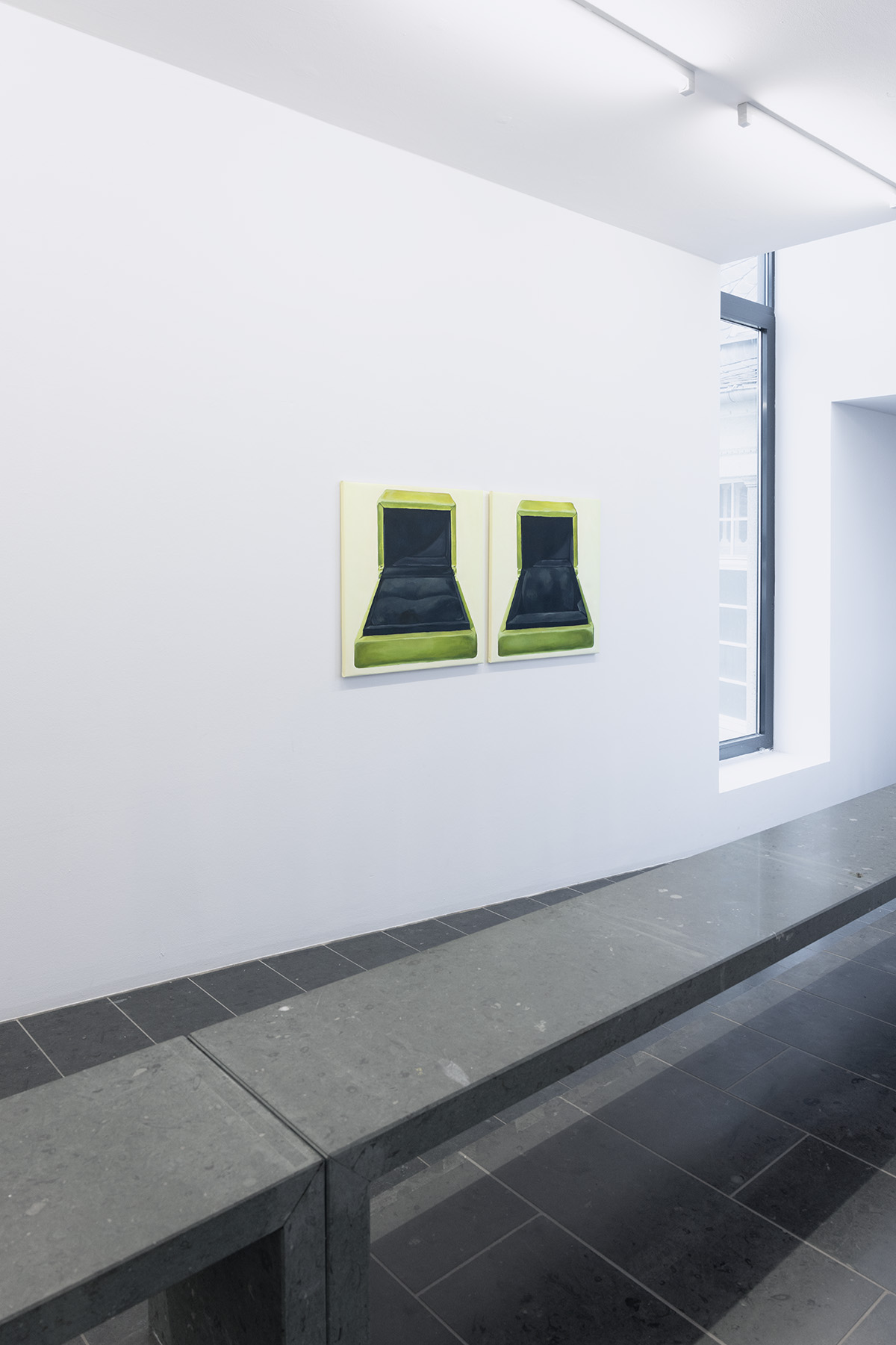
Alibi I-IV, 2025
Ming Yuan
21 x 29 x 2 cm each
Oil on cotton canvas
Öl auf Baumwolle
Alibi V, 2025
Ming Yuan
75x75x2 cm
Oil on cotton canvas
Öl auf Baumwolle
Alibi VI, 2025
Ming Yuan
75x68x2 cm
Oil on cotton canvas
Öl auf Baumwolle
Alibi VII, 2025
Ming Yuan
75x68x2 cm
Oil on cotton canvas
Öl auf Baumwolle
Alibi VIII, 2025
Ming Yuan
75x116x2 cm
Oil on cotton canvas
Öl auf Baumwolle
![]()
![]()
ALIBI (EN)
09.02.25-16.03.25
SCHLEUSE Opelvillen, Kunstverein Rüsselsheim
exhibition text by Alisia Wood
read more
![]()
![]()
A Single Hurt Colour
read more
Ming Yuan
21 x 29 x 2 cm each
Oil on cotton canvas
Öl auf Baumwolle
Alibi V, 2025
Ming Yuan
75x75x2 cm
Oil on cotton canvas
Öl auf Baumwolle
Alibi VI, 2025
Ming Yuan
75x68x2 cm
Oil on cotton canvas
Öl auf Baumwolle
Alibi VII, 2025
Ming Yuan
75x68x2 cm
Oil on cotton canvas
Öl auf Baumwolle
Alibi VIII, 2025
Ming Yuan
75x116x2 cm
Oil on cotton canvas
Öl auf Baumwolle
ALIBI (EN)
09.02.25-16.03.25
SCHLEUSE Opelvillen, Kunstverein Rüsselsheim
exhibition text by Alisia Wood
read more


A Single Hurt Colour
22.11-07.02.2026
Hua International, Berlin
Alberto Giacometti, Göksu Kunak, Kolja Kärtner, Dean Sameshima, Marianna uutinen, and Ming YuanHua International, Berlin
read more
ALIBI (EN)
09.02.25-16.03.25
SCHLEUSE OPELVILLEN
Written by Alisia Wood
Pistachio green Jewellery boxes enveloped in suede leather with no Jewellery to find but the abyss of emptiness. Delicately heroic golden accentuations, enable a subtle play with shadow and light. Though on second glance these tiny boxes carry much more than just air. Perhaps the absence of an object connected to beauty, wealth and status reveals something much richer than the jewellery itself?
Coffin-like positioned and lined in black velvet, the four Paintings named Alibi V, Alibi VI, Alibi VII, Alibi VIII, come in an almost architectural, inorganic dress. Despite the works predominant apollonian approach, one of beautiful order; whilst also beholding a minimal weight of the dionysian with their hidden exaggerated proportions on one hand and on the other, through their depiction of objects that might entice greed and desire.
For ALIBI MING YUAN created portraits; of the replicated empty Jewellery boxes of Van Cleef & Arpels, which is, for those of you who are not familiar with debutant brands, a french luxury jewelry brand. With a mysterious high pricing system, a way for the Brand to hold onto its value and exclusivity, it’s no wonder the high pricing, its exclusivity and therefore unfulfilled desire has led to unlock a phantom-like world of Van Cleef & Arpels on Taobao, a Chinese online shopping website, alongside a range of existing luxury brands whose replicas are widely spread among the many people who won’t let their taste be limited by budget.
In times of economic recession, the class division widens and the fragility of financial security looms larger. It’s no surprise that fashion trends such as old money and quiet luxury are seemingly trying to balance this gap with the illusion of blending into the dying species of the higher middle class. Both are trying to cosplay something that they are clearly not. So to speak is quiet luxury with its high-end quality and handcrafting signature quite not quiet and the old money trend is often imitated by those who are not connected to generational inheritances of wealth. Two opposite ends who might cross paths in the middle — similar to MING YUAN’s work — by taking inspiration from a replicated and therefore affordable version of a high-end luxury object, the limits of accessibility and identity fade.
This notion of aestheticised identity ties into a long history of objectification. In view of the Oriental female figure it shows in particular through exoticism, colonial gaze, reduction of complex human identities to idealised images. Afong Moy, known as The Chinese Lady, was brought to the U.S. by the Carne brothers (1830–1850s) as a living museum exhibit. Her allure stemmed not from nudity but from her decorative resemblance to silk, mahogany, and porcelain.The theory of Orientalism (Cheng) depicts how Asiatic femininity, from a western perspective, was tied to framing Women* by and into objects surrounding them – as ornamental, artificial and portable. This specific form of personhood has been largely overlooked, yet we struggle to process the political, racial and existential implications of a human figure reduced to ornament.
‘My fascination has always been with the hierarchy between frame and image: the ribbon frames the box, the box frames the gift, and the gift frames identity. By elevating the box (an often overlooked layer) to the role of protagonist, I explore how ornamentation conveys value, presentation, and meaning. No longer holding gemstones, these boxes instead reveal how adornment carries the weight of identity and aspiration, blurring the line between materiality and self-perception.’ (Ming Yuan, Artist Statement, 2025).
Ming Yuan challenges the narrative of western fetishised decorative personhood of asiatic femininity simply by removing the decorative aspect – the jewellery. With ALIBI she deepens her theory-driven artistic vision, creates a new frame to explore the tension between interiority and exteriority, examining the dual nature of humanness and invites you to reconsider the intersection of objecthood and personhood.
09.02.25-16.03.25
SCHLEUSE OPELVILLEN
Written by Alisia Wood
Pistachio green Jewellery boxes enveloped in suede leather with no Jewellery to find but the abyss of emptiness. Delicately heroic golden accentuations, enable a subtle play with shadow and light. Though on second glance these tiny boxes carry much more than just air. Perhaps the absence of an object connected to beauty, wealth and status reveals something much richer than the jewellery itself?
Coffin-like positioned and lined in black velvet, the four Paintings named Alibi V, Alibi VI, Alibi VII, Alibi VIII, come in an almost architectural, inorganic dress. Despite the works predominant apollonian approach, one of beautiful order; whilst also beholding a minimal weight of the dionysian with their hidden exaggerated proportions on one hand and on the other, through their depiction of objects that might entice greed and desire.
For ALIBI MING YUAN created portraits; of the replicated empty Jewellery boxes of Van Cleef & Arpels, which is, for those of you who are not familiar with debutant brands, a french luxury jewelry brand. With a mysterious high pricing system, a way for the Brand to hold onto its value and exclusivity, it’s no wonder the high pricing, its exclusivity and therefore unfulfilled desire has led to unlock a phantom-like world of Van Cleef & Arpels on Taobao, a Chinese online shopping website, alongside a range of existing luxury brands whose replicas are widely spread among the many people who won’t let their taste be limited by budget.
In times of economic recession, the class division widens and the fragility of financial security looms larger. It’s no surprise that fashion trends such as old money and quiet luxury are seemingly trying to balance this gap with the illusion of blending into the dying species of the higher middle class. Both are trying to cosplay something that they are clearly not. So to speak is quiet luxury with its high-end quality and handcrafting signature quite not quiet and the old money trend is often imitated by those who are not connected to generational inheritances of wealth. Two opposite ends who might cross paths in the middle — similar to MING YUAN’s work — by taking inspiration from a replicated and therefore affordable version of a high-end luxury object, the limits of accessibility and identity fade.
This notion of aestheticised identity ties into a long history of objectification. In view of the Oriental female figure it shows in particular through exoticism, colonial gaze, reduction of complex human identities to idealised images. Afong Moy, known as The Chinese Lady, was brought to the U.S. by the Carne brothers (1830–1850s) as a living museum exhibit. Her allure stemmed not from nudity but from her decorative resemblance to silk, mahogany, and porcelain.The theory of Orientalism (Cheng) depicts how Asiatic femininity, from a western perspective, was tied to framing Women* by and into objects surrounding them – as ornamental, artificial and portable. This specific form of personhood has been largely overlooked, yet we struggle to process the political, racial and existential implications of a human figure reduced to ornament.
‘My fascination has always been with the hierarchy between frame and image: the ribbon frames the box, the box frames the gift, and the gift frames identity. By elevating the box (an often overlooked layer) to the role of protagonist, I explore how ornamentation conveys value, presentation, and meaning. No longer holding gemstones, these boxes instead reveal how adornment carries the weight of identity and aspiration, blurring the line between materiality and self-perception.’ (Ming Yuan, Artist Statement, 2025).
Ming Yuan challenges the narrative of western fetishised decorative personhood of asiatic femininity simply by removing the decorative aspect – the jewellery. With ALIBI she deepens her theory-driven artistic vision, creates a new frame to explore the tension between interiority and exteriority, examining the dual nature of humanness and invites you to reconsider the intersection of objecthood and personhood.